

Last updated
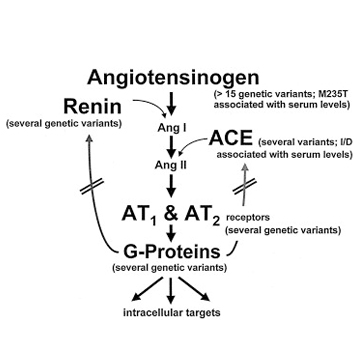
The renin–angiotensin, kallikrein–kinin, and NO systems regulate vascular tone. The common variants below have been investigated in research. They are not independent diagnoses of hypertension or reliable individual predictors of thrombosis, preeclampsia, or treatment response. Routine genetic testing is not recommended for most patients with hypertension; suspected rare monogenic disease requires specialist assessment.
C-5312T Polymorphism in the Renin Gene (REN)
Gene name: REN.
Polymorphism: C-5312T.
Location within the gene: regulatory region.
Genotypes: CC, CT, TT.
Function: REN encodes renin, an enzyme synthesized by renal juxtaglomerular cells in response to decreased blood pressure. It is a proteolytic enzyme of the aspartic protease family. Renin initiates activation of the renin–angiotensin system by catalyzing the enzymatic cleavage of angiotensinogen to angiotensin I.
Molecular characteristics. C-5312T is a cytosine-to-thymine substitution in the REN regulatory region studied in relation to renin expression. A single-variant effect cannot be equated with obligatory activation of the whole system in every carrier.
T704C, Met235Thr Polymorphism in the Angiotensinogen Gene (AGT)
Gene name: AGT.
Polymorphism: T704C.
Chromosomal location: 1q42.2.
Location within the gene: coding region.
Genotypes: TT, TC, CC.
Function: AGT encodes angiotensinogen, a serum globulin synthesized in liver cells. It is the precursor of angiotensin I, which is formed by renin-mediated proteolytic hydrolysis of angiotensinogen. The resulting angiotensin I is biologically inactive and is the precursor of physiologically active angiotensin II.
Molecular characteristics. T704C, Met235Thr is a historical designation for replacement of methionine by threonine at angiotensinogen position 235. Protein-level differences reported in studies are not a fixed 15–20% increase in every carrier.
C521T, Thr174Met Polymorphism in the Angiotensinogen Gene (AGT)
Gene name: AGT.
Polymorphism: C521T.
Chromosomal location: 1q42.2.
Location within the gene: coding region.
Genotypes: CC, CT, TT.
Function: AGT encodes angiotensinogen, a serum globulin synthesized in liver cells. It is the precursor of angiotensin I, which is formed by renin-mediated proteolytic hydrolysis of angiotensinogen. The resulting angiotensin I is biologically inactive and is the precursor of physiologically active angiotensin II.
Molecular characteristics. C521T, Thr174Met denotes replacement of threonine by methionine at angiotensinogen position 174. Its significance should be distinguished from clinical diagnosis of monogenic hypertension.
Alu Ins/Del Polymorphism in the Angiotensin-Converting Enzyme Gene (ACE)
Gene name: ACE.
Polymorphism: Alu Ins/Del (I/D), insertion/deletion of an Alu sequence.
Chromosomal location: 17q23.3.
Location within the gene: regulatory region.
Genotypes: I/I, I/D, D/D.
Function: ACE encodes angiotensin-converting enzyme (ACE), which has carboxypeptidase proteolytic activity. It is one of the most important components of the renin–angiotensin system. Its function is to convert angiotensin I into physiologically active angiotensin II by cleaving the C-terminal dipeptide His-Leu from angiotensin I to form angiotensin II (the octapeptide Asp-Arg-Val-Tyr-Ile-His-Pro-Phe).
Molecular characteristics. Alu Ins/Del denotes presence or absence of an Alu sequence within an ACE intron. Sources differ slightly in the stated length; precise identity should be checked against the reference sequence. Studies associate D with higher average ACE levels, but an individual concentration is not determined by one genotype.
A1166C Polymorphism in the Angiotensin II Type 1 Receptor Gene (AGTR-1)
Gene name: AGTR-1.
Polymorphism: A1166C.
Chromosomal location: 3q24.
Location within the gene: regulatory region.
Genotypes: AA, AC, CC.
Function: AGTR-1 encodes the angiotensin II type 1 receptor (AGTR-1), which raises blood pressure when it binds angiotensin II.
Molecular characteristics. A1166C is a studied noncoding AGTR1 variant. The gene encodes the AT1 receptor. Genotyping does not establish increased receptor expression in an individual patient.
G1675A Polymorphism in the Angiotensin II Type 2 Receptor Gene (AGTR-2)
Gene name: AGTR-2.
Polymorphism: G1675A.
Chromosomal location: Xq23.
Location within the gene: regulatory region.
Function: AGTR-2 encodes the angiotensin II type 2 receptor (AGTR-2), which lowers blood pressure when it binds angiotensin II.
Molecular characteristics. G1675A is a historical designation for a studied AGTR2 variant. The gene is at Xq23 and is not autosomal. In a person with one X chromosome the result is usually hemizygous, rather than one of three diploid genotypes. Numbering and alleles must be checked against the assay.
Ins/Del Polymorphism in the Bradykinin B2 Receptor Gene (BDKRB2)
Gene name: BDKRB2.
Polymorphism: Ins/Del, insertion/deletion of nine nucleotide pairs at positions 21–29 of the polynucleotide sequence of exon 1.
Chromosomal location: 14q32.2.
Location within the gene: noncoding part of exon 1.
Genotypes: I/I (+9/+9), I/D (+9/-9), D/D (-9/-9).
Function: BDKRB2 encodes the bradykinin receptor expressed in vascular endothelium, mediating bradykinin's principal effects. It is the main functional antagonist of angiotensin II.
Molecular characteristics. Ins/Del (+9/-9) concerns a nine-nucleotide sequence in the noncoding portion of BDKRB2 exon 1. It is not an insertion or deletion of three amino acids in the receptor. The B2 receptor transmits bradykinin signals; its concentration cannot reliably be determined from this result alone.
G894T, Glu 298Asp Polymorphism in the Endothelial Nitric Oxide Synthase Gene (NOS3)
Gene name: NOS3.
Polymorphism: G894T.
Chromosomal location: 7q36.1.
Location within the gene: coding region.
Genotypes: GG, GT, TT.
Function: NOS3 encodes endothelial nitric oxide synthase, NOS3.
Molecular characteristics. G894T, traditionally Glu298Asp, concerns replacement of glutamic acid (Glu) by aspartic acid (Asp) at position 298. It is not replacement of glutamine by asparagine. The direction of notation depends on the reference sequence.
T-786C Polymorphism in the Endothelial Nitric Oxide Synthase Gene (NOS3)
Gene name: NOS3.
Polymorphism: T-786C.
Chromosomal location: 7q36.1.
Location within the gene: regulatory region.
Genotypes: TT, TC, CC.
Function: NOS3 encodes endothelial nitric oxide synthase, NOS3.
Molecular characteristics. T-786C is a NOS3 regulatory-region variant studied in relation to transcription. It does not establish coronary spasm or replace clinical investigation.
Sources and professional guidelines
- 2024 ESC Hypertension Guidelines
- ESC Working Group Position Statement on Cardiovascular Pharmacogenomics
- NCBI Gene: AGTR2
- Structure of the Human BDKRB2 Gene
- UniProt: NOS3 Position 298 Variant
Updated: 03.11.2026