

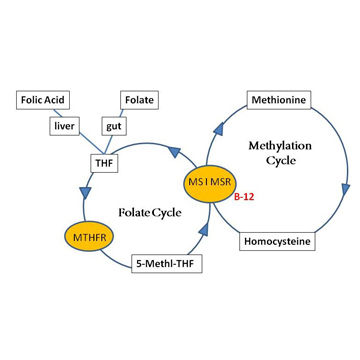
Folates participate in one-carbon transfer, nucleotide synthesis, and methionine and homocysteine metabolism. This pathway depends on several enzymes, folate and vitamin B12 availability, and other factors. Common variants in these genes should not be confused with rare pathogenic variants causing inherited metabolic disorders.
MTHFR C677T (Ala222Val)
MTHFR is located at 1p36.22. The variant is in the coding region; possible genotypes are CC, CT, and TT. In current nomenclature, this common variant is also described as c.665C>T, p.Ala222Val; the traditional name C677T remains widely used.
MTHFR catalyzes conversion of 5,10-methylenetetrahydrofolate to 5-methyltetrahydrofolate, the methyl-group source for remethylating homocysteine to methionine. Replacing alanine with valine at position 222 can reduce enzyme thermostability and activity. The biochemical effect depends on conditions, including nutrition; in vitro activity percentages are not an individual disease prediction.
A T allele does not necessarily produce hyperhomocysteinemia and is not, by itself, a diagnosis of thrombophilia, a cause of infertility, or evidence of fetal harm.
MTHFR A1298C (Glu429Ala)
The gene is located at 1p36.22. The variant is in the coding region; genotypes are AA, AC, and CC. Its current designation is c.1286A>C, p.Glu429Ala. The substitution affects the glutamic acid residue at position 429.
It cannot be assumed that this variant reduces enzyme activity by 65% in every carrier or inevitably raises homocysteine. Evidence that A1298C alone significantly disrupts folate processing is insufficient. It is not an independent clinical test of thrombosis, cancer, or birth-defect risk.
MTR A2756G (Asp919Gly)
MTR is located at 1q43. The variant is in the coding region; genotypes are AA, AG, and GG. It substitutes glycine for aspartic acid at position 919 of methionine synthase.
MTR encodes vitamin-B12-dependent methionine synthase. With cobalamin, the enzyme transfers a methyl group from 5-methyltetrahydrofolate to homocysteine, producing methionine. Methionine is needed, among other roles, to produce S-adenosylmethionine, a methyl donor in numerous reactions. This reaction does not require direct replacement of the cyano group of dietary cyanocobalamin on the enzyme.
The common A2756G variant is not equivalent to inherited MTR deficiency. Its presence does not establish reduced catalytic activity in an individual patient or increased thrombosis risk.
MTRR A66G (Ile22Met)
MTRR is located at 5p15.31. The variant is in the coding region; genotypes are AA, AG, and GG. It substitutes methionine for isoleucine at position 22.
Methionine synthase reductase sustains methionine synthase function by restoring its active state after oxidative inactivation. Research associations involving A66G do not equate ordinary AG or GG genotypes with monogenic enzyme deficiency, inevitable hyperhomocysteinemia, or DNA damage.
SLC19A1: Reduced Folate Carrier
The gene is located at 21q22.3; RFC1 is a historical synonym. Its product is a membrane folate transporter. The common rs1051266 variant is often designated 80G>A (Arg27His); older reports may use the reverse notation A80G. It is a coding variant, not a promoter variant. Precise nomenclature requires the selected reference sequence.
Possible genotypes using A/G notation are AA, AG, and GG. Studies of associations with folate levels and reproductive outcomes have produced heterogeneous findings. Previously stated risk ratios of 2.4 and 1.5 cannot be applied to an individual pregnancy or used to select a folic acid dose.
Clinical Interpretation
These common polymorphisms do not have a simple autosomal dominant clinical inheritance pattern. Frequencies differ between populations, so unverified universal percentages are not provided.
Routine MTHFR testing is not recommended for thrombophilia diagnosis or recurrent pregnancy loss assessment. These genotypes are not an indication for anticoagulants. When a metabolic disorder is suspected, a clinician assesses the clinical findings and, when indicated, homocysteine, folate, and B12. Homocysteine is usually measured in μmol/L; its reference interval is laboratory-dependent, rather than “up to 15 ng/mL.”
People with ordinary MTHFR variants can process folic acid. The general recommendation for people who could become pregnant is 400 μg of folic acid daily; the genotype alone does not require a different form or higher dose. Individual indications for a higher dose, such as a particular obstetric history, are determined by a clinician.
Sources and professional guidelines
- ACMG Practice Guideline: Lack of Evidence for MTHFR Polymorphism Testing
- CDC: MTHFR Gene Variant and Folic Acid Facts
- CDC: Folic Acid Facts for Clinicians
- MedlinePlus Genetics: MTRR
- PharmGKB: SLC19A1 Pharmacogenomics Summary
- British Society for Haematology: Thrombophilia Testing
- NCBI Medical Genetics Summaries: MTHFR Deficiency and Modern Variant Nomenclature
Updated: 03.11.2026