

Last updated
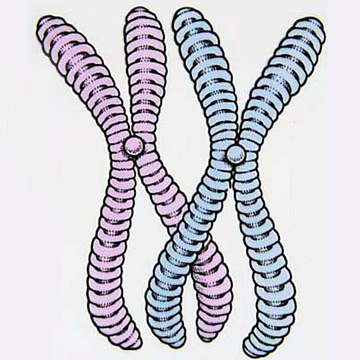
An allele is one of the possible DNA sequence variants at a particular genomic location, such as a version of a gene. Alleles of the same gene occupy corresponding locations, or loci, on homologous chromosomes. Different alleles may influence a trait, but not every DNA variant causes an observable change or a disease.
In a typical human diploid cell, an autosomal locus has two copies: one inherited from the mother and one from the father. They may be identical or different. A reproductive cell usually contains one copy of that locus. Exceptions occur with sex chromosomes and changes in DNA copy number.
Many alleles of a gene may exist in a population; their number is not limited to two. New variants arise through changes in the DNA sequence, called mutations. Such changes may be neutral, affect a trait or have clinical significance; their effect depends on the particular variant and its biological context.
The presence of more than two alleles at a locus in a population is called multiple allelism. Different alleles may correspond to either different or identical forms of a trait. Allelic variation is one of the foundations of genetic diversity within a population.
Sources and professional guidelines
Updated: 03.11.2026