

Last updated
Deoxyribonucleic acid (DNA) is a biopolymer whose sequence stores hereditary information. Its nucleotides contain 4 main types of nitrogenous base. DNA carries instructions for making RNA and proteins and helps regulate cellular activity. How these instructions are used also depends on cellular mechanisms and environmental conditions. Human nuclear chromosomes contain linear DNA, while mitochondria contain a small circular DNA molecule.
Each DNA strand consists of nucleotides containing deoxyribose, a phosphate group and a nitrogenous base. Adjacent nucleotides are joined by phosphodiester bonds between a sugar's 3′-OH group and the next nucleotide's 5′-phosphate group. This forms the sugar-phosphate backbone of the polynucleotide strand.
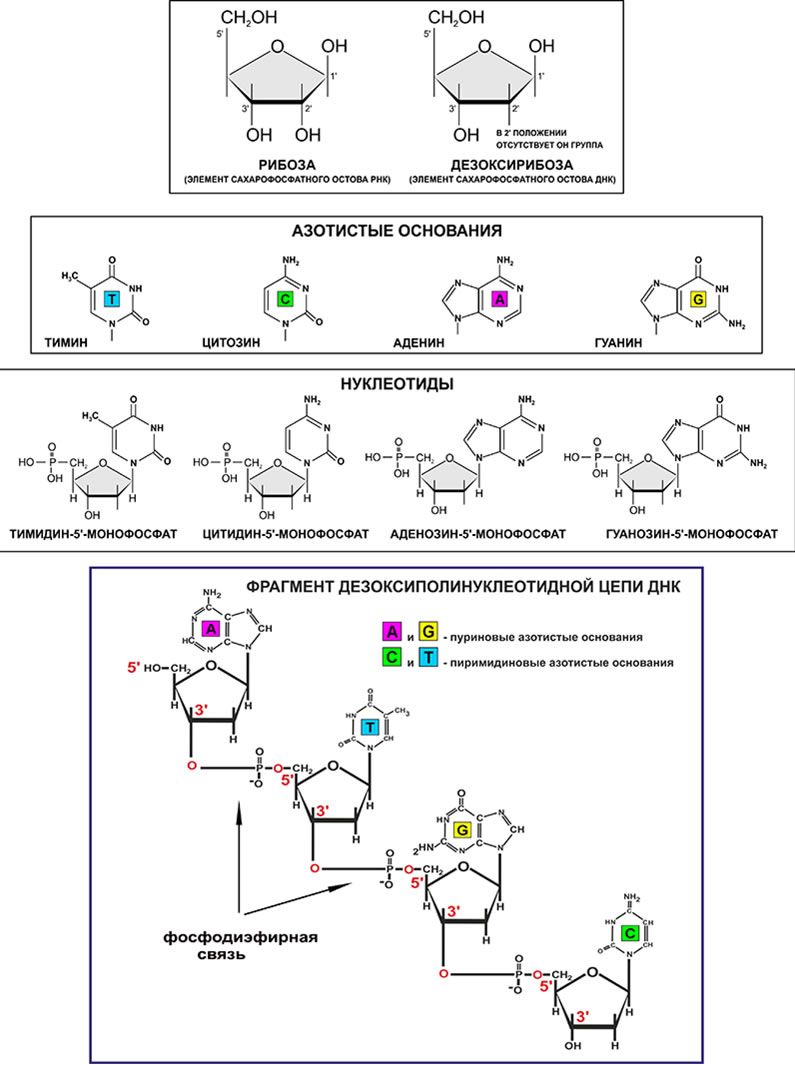
Fig. 1. Ribose and deoxyribose, nitrogenous bases, nucleotides and a segment of a DNA strand. Adenine (A) and guanine (G) are purine bases, while cytosine (C) and thymine (T) are pyrimidine bases. The arrow in the lower part indicates a phosphodiester bond.
Two antiparallel strands form the DNA double helix. Bases interact through complementarity: adenine pairs with thymine, and guanine with cytosine. Hydrogen bonds form between the bases within each pair.
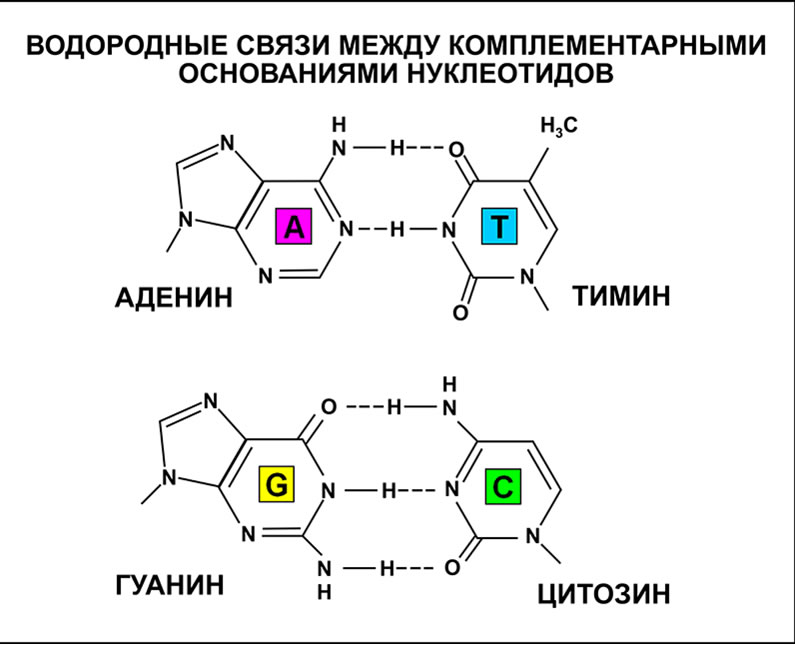
Fig. 2. Hydrogen bonds between complementary A–T and G–C base pairs.
Complementarity allows DNA to be copied during replication. DNA polymerase uses a template strand and deoxyribonucleoside triphosphates as substrates to build the daughter strand. To start extension, it needs a primer with a free 3′-OH group. The enzyme adds complementary nucleotides to that end, so the new strand grows in the 5′→3′ direction. Proofreading and repair systems support high copying accuracy, although errors are not completely eliminated.
The DNA sequence contains genes for different types of RNA. During transcription, RNA polymerase synthesizes RNA using DNA as a template. Messenger RNA (mRNA) carries information for protein synthesis; ribosomal RNA (rRNA) forms part of ribosomes, and transfer RNA (tRNA) delivers amino acids. Other functional RNAs also exist and are not translated into proteins.
The usual pathway for expressing a protein-coding gene is described as DNA→RNA→protein. This does not mean that every biopolymer serves as a template for making any subsequent one. DNA templates DNA during replication and RNA during transcription. During translation, a ribosome reads the mRNA sequence according to the genetic code, while tRNAs help incorporate the corresponding amino acids into the growing protein chain. RNA can itself be the final functional product of gene expression.
Sources and professional guidelines
- NHGRI: Deoxyribonucleic Acid (DNA)
- NHGRI: Mitochondrial DNA
- MedlinePlus Genetics: How genes direct protein production
- NCBI Bookshelf: Studying DNA — DNA polymerases and primers
Updated: 03.11.2026