

Last updated
During cell division, genetic information is passed to daughter cells through prior duplication of DNA. This process is called replication. The new copies are virtually identical to the original DNA, although rare errors remain possible despite proofreading systems.
Replication is semiconservative: each new molecule contains one parental strand and one newly synthesized strand. This preserves the sequence of genetic information as cells multiply.
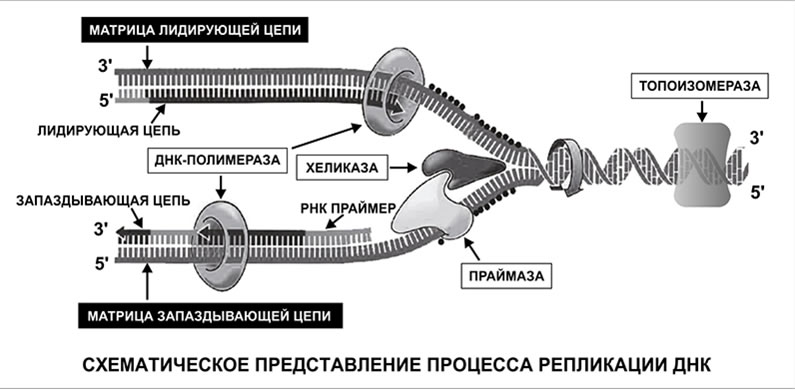
The process begins at initiation sites. Helicase separates the two strands of the double helix by disrupting interactions between complementary bases. Topoisomerases relieve the resulting tension and supercoiling by temporarily breaking and subsequently rejoining DNA strands.
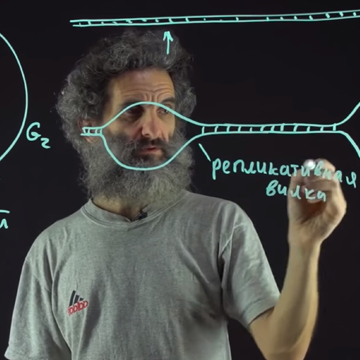
The unwound region forms a replication fork. A protein complex travels with it, synthesizing a complementary daughter strand from each template strand. Speed depends on the organism and conditions and cannot be described by one universal value.
DNA strands are antiparallel and have 3′ and 5′ ends. DNA polymerase reads the template in the 3′→5′ direction and extends the new strand in the 5′→3′ direction by adding nucleotides to its free 3′ hydroxyl group. The leading strand is therefore synthesized mainly continuously, while the lagging strand is synthesized as separate Okazaki fragments.
DNA polymerase cannot initiate synthesis from scratch: it needs a primer with an accessible 3′ end. A primer is required to initiate both daughter strands; on the lagging strand, every new fragment requires a new primer. In eukaryotes, the primase–DNA polymerase α complex first makes a short RNA primer and then adds a short DNA segment. Other replicative polymerases, primarily ε and δ, perform most elongation.
RNA primers are subsequently removed, gaps are filled with DNA, and DNA ligase joins neighboring fragments, restoring continuity of the sugar-phosphate backbone. Polymerase proofreading and subsequent repair increase the accuracy of genetic information transfer.
Sources and professional guidelines
Updated: 03.11.2026