

Last updated
A gene is a unit of hereditary information: a DNA segment involved in producing a functional RNA or protein product. One gene can produce several products through alternative RNA processing. Gene products work together in the development and functioning of the organism.
Promoters and other regulatory sequences regulate gene activity. Some are near the gene and others a considerable distance away. Gene boundaries and the concept of its regulatory region depend on the definition used; a gene should not be considered a physically or functionally indivisible molecule.
Chromosome
Chromosomes are nucleoprotein structural and functional entities located in the nuclei of eukaryotic cells.
Chromosomes store and implement hereditary information and, most importantly, transmit this information from generation to generation.
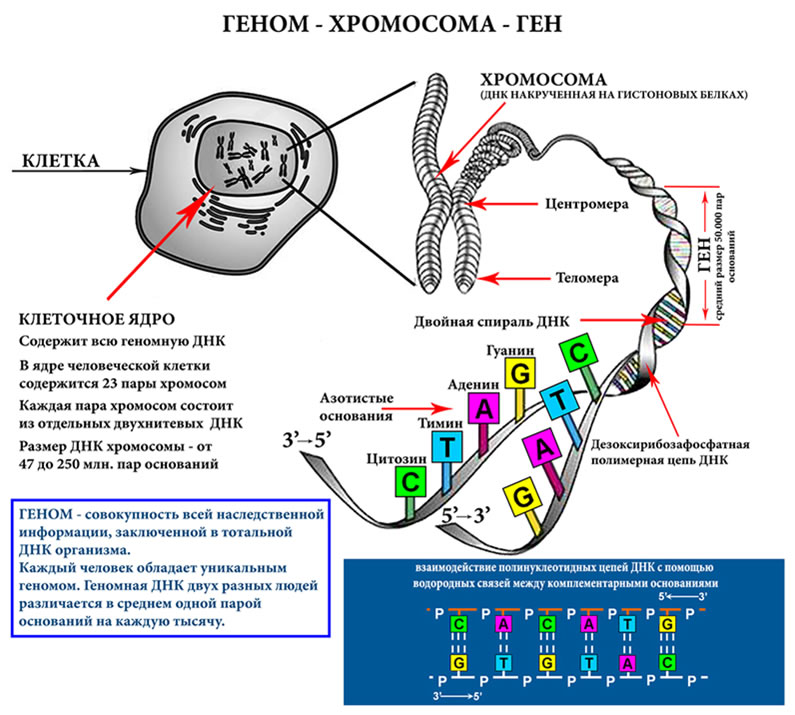
Structurally, a chromosome consists of one long molecule of double-stranded DNA (47–250 million base pairs) tightly wound around histone proteins. Each chromosome contains numerous unique genes characteristic exclusively of that chromosome.
Most human nucleated somatic cells contain two copies of each autosome, one from each parent. Germ cells usually contain one set. The X and Y sex chromosomes differ and are not completely homologous.
A typical human diploid complement has 46 chromosomes: 22 autosome pairs and one sex chromosome pair. Sex development involves chromosomes, genes, and hormonal mechanisms, rather than merely the number of one pair.
A typical female karyotype is 46,XX: one X chromosome comes from the mother and one from the father. The paternal X originates from his maternal lineage.
A typical male karyotype is 46,XY: the X comes from the mother and the Y from the father. Other numerical and structural sex chromosome patterns also occur.
The X chromosome is considerably larger than the Y and contains more genes. Exact counts depend on the genome annotation version and whether only protein-coding genes or other gene types are included.
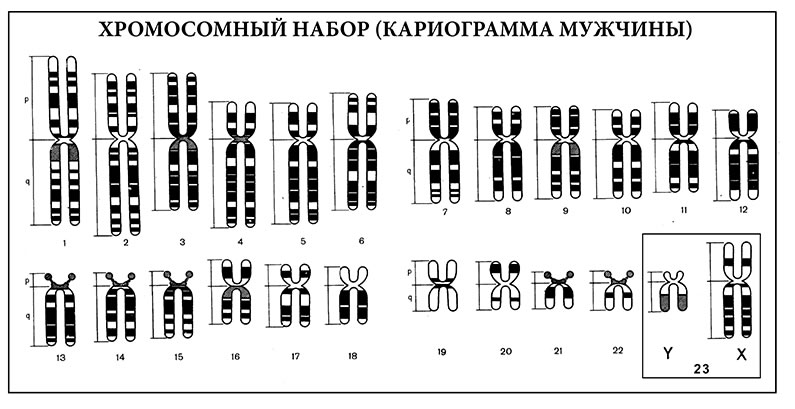
The figure schematically shows a male chromosome complement (karyogram). It depicts 23 pairs of chromosomes, stained and numbered in order of decreasing size. The presence of a Y chromosome in the 23rd pair establishes that this is a male karyogram.
The centromere is a specialized chromosome region important for segregation during division. It separates the short p arm from the long q arm; it is not the junction between two homologous chromosomes.
Differential staining gives chromosomes a characteristic banding pattern. Locations are numbered from the centromere toward the arm tip. For example, MTHFR is at 1p36.22: chromosome 1, short arm p, region 3, band 6, subband 2, and finer sub-subband 2. It does not mean “band 22 of region 36.”
Genome
The genome is the complete complement of genetic material. One human haploid nuclear set contains 23 chromosomes and approximately 3 billion base pairs; an ordinary diploid somatic cell contains two such sets. Cells also contain mitochondrial DNA.
The human genome contains approximately 20,000 protein-coding genes and numerous functional RNA genes. Protein-coding sequences occupy only a small part of the genome. Noncoding DNA should not be treated as exclusively “junk”: it includes regulatory sequences and RNA gene regions, among other elements.
Genes are separated by intergenic regions, but their organization is complex: they can overlap and have different transcripts. Intergenic regions contain regulatory sequences and other noncoding DNA.
The human genome contains numerous regulatory regions whose function is to control gene expression (the synthesis of messenger RNA from a segment of a DNA molecule). Regulatory regions are usually short sequences located either near a gene or within it. Sometimes they are located a considerable distance from the gene (enhancers).
Sources and professional guidelines
- MedlinePlus Genetics: What Is a Gene?
- MedlinePlus Genetics: What Is a Chromosome?
- MedlinePlus Genetics: Gene Locations
- NHGRI: Gene
Updated: 03.11.2026