


Last updated
Arterial hypertension is persistently elevated blood pressure. It may cause no noticeable symptoms for a long time, including in younger people. Feeling well does not replace blood pressure measurement. Diagnosis and treatment reduce complications but do not guarantee a complete cure.
Women planning pregnancy should discuss hypertension and medication with a clinician beforehand. Hypertensive disorders increase adverse maternal and infant outcome risks. Venous thromboembolism risk in pregnancy is assessed separately, rather than attributed to high blood pressure alone.
Hypertensive Disorders in Pregnancy
- Chronic hypertension is present before pregnancy or identified before 20 weeks. Even mild disease requires monitoring and assessment for preeclampsia.
- Gestational hypertension first develops after 20 weeks in a previously normotensive woman, without diagnostic features of preeclampsia. It may progress; absence of symptoms does not guarantee a favorable outcome.
- Preeclampsia usually develops after 20 weeks: hypertension accompanies proteinuria and/or other organ dysfunction. It can complicate chronic hypertension and present after delivery. Hyperuricemia alone does not establish the diagnosis.
- Eclampsia is a seizure complication of preeclampsia requiring emergency care, rather than a synonym for it.
Possible complications include stroke, pulmonary edema, kidney and liver injury, coagulation abnormalities, placental abruption, fetal growth restriction, and preterm birth. Their likelihood depends on disease severity, gestational age, and accompanying factors; unverified universal percentages are not provided.
Mechanisms and Genetics
Blood pressure regulation involves the renin–angiotensin and kallikrein–kinin systems, endothelium, kidneys, and other mechanisms. Hypertension is usually multifactorial. Common polymorphisms in these genes are not independent diagnoses or reliable individual predictors of pregnancy complications. Routine treatment selection from them is not established.
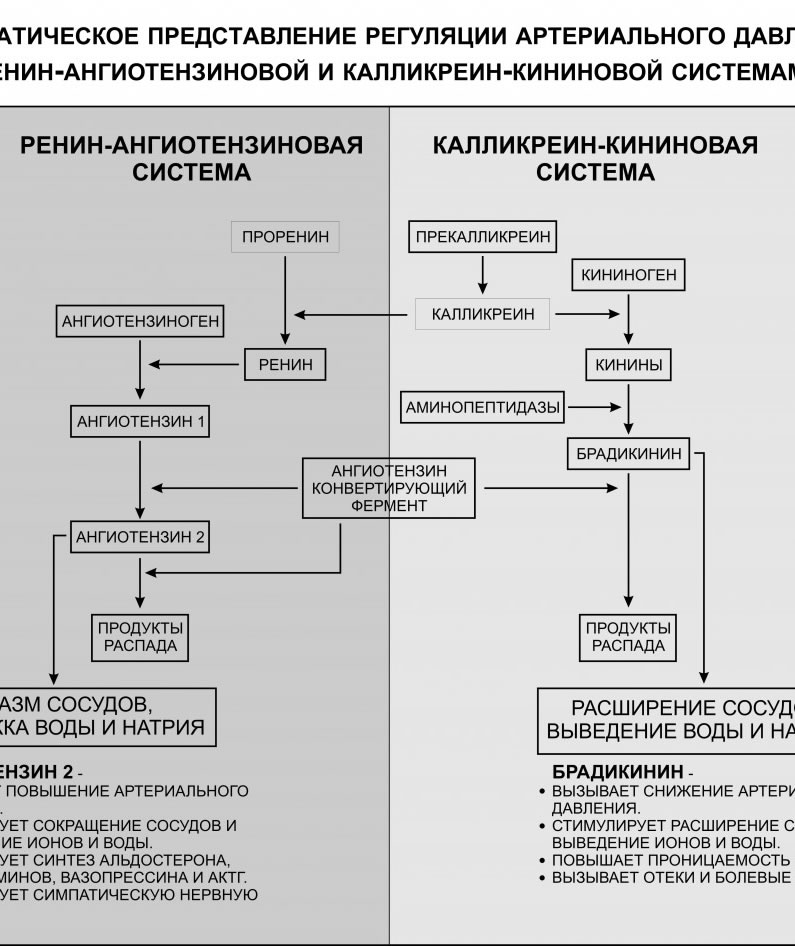
Renin (REN) is a proteolytic enzyme of the aspartic protease family, formed from a precursor in renal juxtaglomerular cells. Secretion is regulated by renal perfusion, NaCl delivery to the macula densa, and sympathetic activity. Renin cleaves angiotensinogen to form angiotensin I. Prorenin activation is not an obligatory process mediated by kallikrein alone.
Angiotensinogen (AGT) is the physiological substrate of renin. It is a plasma protein in the alpha-2-globulin group. Renin converts angiotensinogen into the biologically inactive decapeptide angiotensin I (Asp-Arg-Val-Tyr-Ile-His-Pro-Phe-His-Leu), the precursor of angiotensin II, the physiologically active form of angiotensin.
Angiotensin-converting enzyme (ACE) is a peptidase found, among other sites, on vascular endothelium. It removes C-terminal His-Leu from angiotensin I to form angiotensin II (Asp-Arg-Val-Tyr-Ile-His-Pro-Phe). Angiotensin II affects vascular tone, aldosterone secretion, and fluid and electrolyte balance.
Angiotensin II receptors (AGTR1 and AGTR2) transmit cellular signals. AT1-mediated effects usually include vasoconstriction and sodium retention. AT2 effects depend on tissue and context and may oppose some AT1 effects; these are not simple switches for raising and lowering blood pressure.
Bradykinin B2 receptor (BDKRB2). Bradykinin, the principal antagonist of angiotensin II, is a component of the kallikrein–kinin system.
Bradykinin is released from kininogen by kallikreins. Describing its formation as an obligatory kininogen–kinin–bradykinin sequence mediated by aminopeptidases is inaccurate.
Bradykinin is an oligopeptide consisting of nine amino acid residues (Arg-Pro-Pro-Gly-Phe-Ser-Pro-Phe-Arg) and is one of the most effective vasodilators (a vasodilator is a compound that dilates blood vessels).
Bradykinin acts through receptors including B2 (BDKRB2). ACE also contributes to its breakdown. Testing a single polymorphism does not measure the overall activity of the system.
Thus, kallikrein and angiotensin-converting enzyme, belonging to the kallikrein–kinin and renin–angiotensin systems respectively, unite these into a single biochemical system for blood pressure regulation.
Endothelial NO synthase (NOS3) contributes to nitric oxide (NO) production. Reduced NO bioavailability may contribute to endothelial dysfunction and increased vascular tone.
NO relaxes vascular smooth muscle and inhibits platelet activation and adhesion. Its effects depend on local production and inactivation, not concentration alone. A change in system activity does not by itself calculate thrombosis risk.
NOS3 uses L-arginine to synthesize NO. NO is a short-lived signaling molecule whose production is regulated at multiple levels. A common NOS3 variant does not establish dysfunction of this system in an individual.
Sources and professional guidelines
- ACOG: Preeclampsia and High Blood Pressure During Pregnancy
- NICE NG133: Hypertension in Pregnancy
- 2024 ESC Hypertension Guidelines
- IUPHAR/BPS: Angiotensin AT2 Receptor
Updated: 03.11.2026