


Last updated
The renin–angiotensin and kallikrein–kinin systems help regulate vascular tone, salt and water balance, and blood pressure. The variants below involve genes in these systems and endothelial NO synthase and have been studied in hypertension-association research.
Most hypertension is multifactorial. Routine genetic testing for diagnosis or treatment selection is not recommended. Suspected rare monogenic forms warrant targeted testing in a specialist center. A relative with hypertension does not itself justify this candidate-gene panel.
Molecular effects depend on experimental conditions, population and other genetic factors. The mechanisms and associations described are not guaranteed individual predictions. These variants cannot automatically diagnose hypertension, thrombosis, preeclampsia or osteoarthritis, or determine antihypertensive prescribing, contraception, hormone therapy or prevention of pregnancy complications.
Common polymorphisms should not be presented as separate autosomal dominant diseases. AGTR2 is on the X chromosome (Xq23): people with one X chromosome generally have one tested allele rather than a diploid pair. Paired genotypes listed for this gene apply to people with two X chromosomes.
The variant names below are mainly historical; the exact sequence and assay coverage must be checked before testing. Allele frequencies are not universal, so the earlier percentages and individual risk ratios are not reproduced.
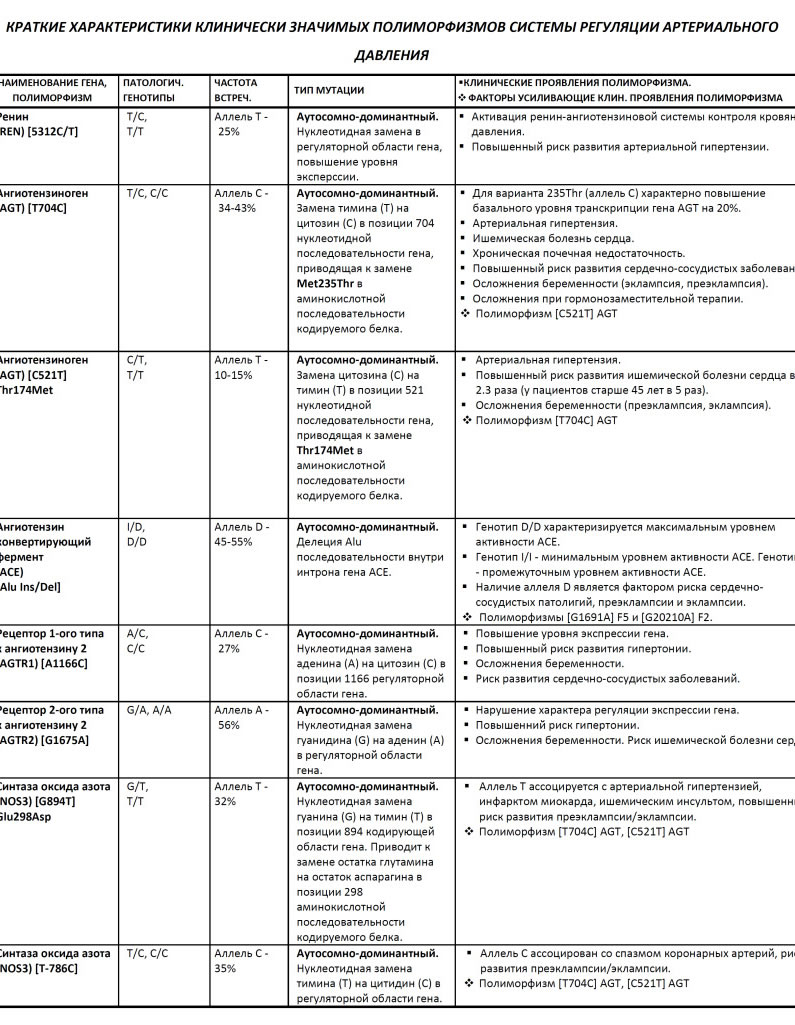
C-5312T Polymorphism in the Renin Gene (REN)
Gene: REN
Historical variant designation: C-5312T
Region: regulatory
Genotypes: CC, CT, TT
REN encodes renin, an aspartic protease produced by the kidney's juxtaglomerular cells. Renin cleaves angiotensinogen to form angiotensin I and initiates the renin–angiotensin system. C-5312T is a historical designation for a cytosine-to-thymine substitution in a regulatory region. It has been studied in relation to REN expression; it does not establish an individual's hypertension risk.
T704C, Met235Thr Polymorphism in the Angiotensinogen Gene (AGT)
Gene: AGT
Historical variant designation: T704C / Met235Thr
Region: coding
Genotypes: TT, TC, CC
AGT encodes angiotensinogen, a protein synthesized mainly in the liver. Renin cleaves it to form angiotensin I, which is subsequently converted to the more active angiotensin II. The historical T704C/Met235Thr designation describes a methionine-to-threonine change at position 235. Associations with angiotensinogen concentrations have been studied, but are not a universal quantitative effect or an individual diagnostic prediction.
C521T, Thr174Met Polymorphism in the Angiotensinogen Gene (AGT)
Gene: AGT
Historical variant designation: C521T / Thr174Met
Region: coding
Genotypes: CC, CT, TT
AGT encodes angiotensinogen, the precursor used by renin to form angiotensin I. The historical C521T/Thr174Met designation describes a threonine-to-methionine substitution at position 174. Its presence alone does not diagnose hypertension or determine treatment.
Alu Ins/Del Polymorphism in the Angiotensin-Converting Enzyme Gene (ACE)
Gene: ACE
Historical variant designation: Alu Ins/Del
Region: noncoding
Genotypes: I/I, I/D, D/D
ACE encodes angiotensin-converting enzyme. It converts angiotensin I to angiotensin II by removing a terminal His–Leu dipeptide and also participates in bradykinin breakdown. The Alu insertion/deletion is a noncoding variant. Associations with ACE activity do not mean that it alone determines enzyme concentrations or disease risk.
A1166C Polymorphism in the Angiotensin II Type 1 Receptor Gene (AGTR-1)
Gene: AGTR1
Historical variant designation: A1166C
Region: regulatory
Genotypes: AA, AC, CC
AGTR1 encodes the angiotensin II type 1 receptor, which mediates many vasoconstrictor and sodium-retaining effects of angiotensin II. A1166C is a historical designation for an adenine-to-cytosine substitution in a regulatory region. Reported molecular associations do not establish a universal change in receptor expression or a genotype-specific treatment rule.
G1675A Polymorphism in the Angiotensin II Type 2 Receptor Gene (AGTR-2)
Gene: AGTR2
Historical variant designation: G1675A
Region: regulatory
Genotypes: GG, GA, AA
AGTR2 encodes the angiotensin II type 2 receptor. Its effects depend on tissue and biological context and may counter some type 1-receptor effects; it cannot simply be described as always lowering blood pressure. G1675A is a historical regulatory-variant designation. AGTR2 is X-linked, so paired genotypes below apply to people with two X chromosomes; people with one X usually have one allele at this locus.
Ins/Del Polymorphism in the Bradykinin B2 Receptor Gene (BDKRB2)
Gene: BDKRB2
Historical variant designation: Ins/Del (+9/−9)
Region: first exon, noncoding
Genotypes: I/I (+9/+9), I/D (+9/−9), D/D (−9/−9)
BDKRB2 encodes the bradykinin B2 receptor, which mediates important vascular actions of bradykinin. The historical insertion/deletion concerns 9 nucleotide pairs in the first exon; it is not a protein-coding deletion. Bradykinin is a peptide of 9 amino-acid residues. Binding to B2 receptors promotes vasodilatory signaling, but the variant alone is not a thrombosis or hypertension test.
G894T, Glu298Asp Polymorphism in the Endothelial Nitric Oxide Synthase Gene (NOS3)
Gene: NOS3
Historical variant designation: G894T / Glu298Asp
Region: coding
Genotypes: GG, GT, TT
NOS3 encodes endothelial nitric oxide synthase, which produces nitric oxide from L-arginine and participates in vascular-tone regulation. G894T describes a guanine-to-thymine substitution associated with glutamate (Glu) being replaced by aspartate (Asp) at position 298. Glu and Asp do not mean glutamine and asparagine. The variant does not independently predict disease.
T-786C Polymorphism in the Endothelial Nitric Oxide Synthase Gene (NOS3)
Gene: NOS3
Historical variant designation: T-786C
Region: regulatory
Genotypes: TT, TC, CC
NOS3 encodes endothelial nitric oxide synthase. T-786C is a historical designation for a thymine-to-cytosine substitution in a regulatory region. Effects on transcription have been investigated, but depend on experimental and genetic context. The result alone does not justify medication, pregnancy-risk prediction or a diagnosis.
Sources and professional guidelines
- 2024 ESC Guidelines for elevated blood pressure and hypertension
- NCBI Gene: AGTR2, X-linked angiotensin II receptor type2
- IUPHAR/BPS: Angiotensin AT2 receptor
Updated: 03.11.2026